Sunday, 15 March 2015

'Magician' by Raymond E Feist

Colossal, compelling, exciting and imaginative, Raymond E Feist's now classic, original fantasy 'Magician' is as fantastic as I remember it years ago. I was thirteen when my tutor allowed me to borrow this huge book. He told me that he had devoured it in ten hours on one coach journey and thought that as I had expressed a love of 'Lord of the Rings' that I would also love Feist's epic. He was right. 'Magician' is a worthy successor to Tolkien's mythopoeic series and a precursor to the scope of 'Game of Thrones'. And I loved reading it now as much as I did at thirteen when I read late into the night, even dreaming about it in vivid, spectacular detail.

The story may seem cliche today: a young, orphan boy is apprenticed to a master magician, before a great war breaks out threatening the existence of all, until the young boy grows up to be the greatest magician in the land. We've had 'Harry Potter' since, so returning to the character of Pug in a strange, yet familiar world called Midkemia comes with its inevitable baggage. Fortunately, though, any comparisons are swiftly brushed aside. 'Magician' is unique in that once you are accustomed to the idea of Midkemia (a world recognized as distinct as Middle Earth) we are then introduced to a whole new world, Kelewan, which is more Eastern than Western Middle Ages. From Kelewan, the Tsurani  cross a rift through space and time to launch an invasion into Pug's seemingly peaceful world. Immediately this shatters any expectations of cliche we may have harboured. Instead, Raymond E Feist expands our preconceptions of what makes a traditional fantasy and we are quickly consumed by a story far more complex and imaginative. Imagine the ancient Japanese teleporting into Middle Earth using a magic more akin to mastering quantum mechanics, and you get an idea of what 'Magician' is all about. With this twist in concept, the story is propelled from what could have been a bog standard fantasy into something far more dynamic, bold and brilliant.

At a near 700 pages, the story is dense but never without a dull moment. There is a rich cast of characters from both worlds: kings, princes, princesses, magicians, priests, servants, slaves, soldiers, elves, goblins and other strange beasts we have never met before in traditional fantasy. We care for the characters too and they change, for better or worse, over a couple of decades of narrative. There are twists and turns which leave you wondering until the final pages. And then you realize, with joy, that this is actually the first book in a larger series, focusing on different aspects of both Midkemia and Kelewan.

If you love 'Lord of the Rings' or 'Games of Thrones', then 'Magician' will certainly be enjoyed in equal measure. I will hold back from reading the sequels just yet, all else I will read nothing else all year!

Tuesday, 10 March 2015

The Benefits of Mindfulness Part 1

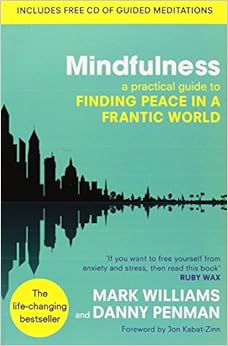
Here we are. Being aware. And I'm aware that I haven't written my blog in a while- for good reason. Despite the fact I have been reading three books at once, I have started my own course of 'mindfulness' based on the hugely popular book 'Mindfulness: a practical guide to finding peace in a frantic world' by Mark Williams and Danny Penman. Some may approach this with a degree of cynicism, but the benefits of this practice  (and it is a practice) is profound. I am on Week Three and I have already changed my job, stopped drinking coffee and found a sense of calm when usually, as a teacher, I have been stressed to the bone!

All mindfulness demands is a little bit of discipline to practice some guided meditations at least twice a day for no more than twenty minutes at a time. Considering some people will pop a pill or two twice a day to combat depression or anxiety, it is perhaps more beneficial to consider mindfulness as a natural alternative which is ultimately more rewarding. It is your mind, after all, and it deserves special attention.

From the ages of sixteen to about twenty-five I had been vulnerable to bouts of depression and anxiety, It is a brave thing to admit this, and at the time I found it hard to acknowledge or talk about.  Nonetheless more and more people today are 'coming out' about such conditions and I think this is right. At university I suffered such extreme panic attacks that once I collapsed against a fence walking into town. I felt there were no options; I was trapped. Although I don't suffer this anymore, I am, like a lot of people, prone to daily stresses and anxieties which could, if unchecked, spiral down into unmanageable negativity. The world isn't slowing down; it is a mad rush. Internet, social media, mobile phones, a hundred different passwords, emails, busy trains, longer working hours, higher prices, higher expectations and economic instability are all the causes for a very modern set of stresses affecting many people's mental health and well being. Children are being diagnosed with far more conditions and behavioural or emotional issues, arguably as a result of this increasingly frantic and materialistic world, which even the parents find difficult to contend with.

Mindfulness is a practice designed not to remove these stresses but to help discover a sense of calm in our whole being and to accept the world around us. It is also a means for becoming more open, less selfish, and more aware of our relationship between our body, mind and the external world. Of course, some may dismiss this all as New Age mumbo-jumbo or be put off by its religious or spiritual connotations, but it is not this. Mindfulness is simply a set of tools, a practice, to find a sense of peace and acceptance in YOU. It is not critical or preachy and practices involve simple breathing techniques, body scans, basic yoga stretches and 'habit releasers' which include activities like going to the cinema to watch something unusual or watching TV 'mindfully'. By practicing, even for twenty minutes a day, the benefits are felt mentally, emotionally and physically. A scientific study has even proven that mindfulness, done purposefully, can alter brain states to make an individual more happy and more calm by shifting the activity of awareness away from the frontal lobe of the brain.

I am merely on Week Three and I have noticed the benefits. This is not to say that I am calm all the time or that I have run off to be a priest on a mountain. But I have felt significantly calmer and more aware of my thought processes. The result has been that I went to an interview for a new job, at a new school, and taught a lesson completely calmly, enjoying it in fact. When I was formally interviewed I was calm, open and positive and in consequence I got the job. This might have been a bigger deal other times, but I was accepting and a sense of peace washed over me. Even heading off to work, I no longer rush. I am more mindful of eating well in the morning and taking my time to notice the world around me when I walk to the train. And now I realize that I have enough time anyway, and that the rush, the frantic nature of life is pointless. I am developing a greater sense of awareness and I am more willing to accept and enjoy what I have.

Above all else, I am enjoying reading the book (with its CD of guided meditations) which is taking me on a real journey of self discovery. I may have a sudden breakdown, but I feel I could accept that. We shall see. I will keep you posted on how I get along...


Monday, 9 February 2015

'Changed Souls' by Harriet Truscott

I was bought this for Christmas because I was seen to be enjoying dystopian fiction and my surname was in the title. I must admit I was a bit dubious at first, as I realized the book was published by the author: Sound and Fury Press. Should this alter my judgement? The blurb, however, intrigued me: an authoritarian regime, incinerating bodies, rationing, a murder and a virus. What more could you ask for in a dystopian novel? Therefore I put my doubts aside and got round to reading it. And I must say I'm glad I did. I raced through the first chapters. It read like the best of thrillers, although it is genre unspecific. Thriller, horror, dystopia, crime, alternative history, science-fiction, take your pick! It is completely engrossing in its indefinable otherness.

The story centres on Lucille, a seventeen year old Patroller in an alternative 1920s American metropolis. With her experienced partner Hank, Lucille's job is to collect the dead bodies of those contaminated by a deadly virus, causing horrifying skeletal mutations. But on a routine pick-up Lucille and Hank stumble on a murder scene, with sinister connections to the Mayor. Is there a cover up? Is there corruption at the heart of the city's governance? Is there more to the virus than Lucille knows?

The premise reads like a typical crime set-up, but as a whodunit set in a well-realized dysfunctional alternative America. Truscott expertly balances the realization of her own dystopia with the pace and tension of a taut, atmospheric thriller. It whips like the very best modern crime novel but frames itself like a film noir: viral prohibition meets Fahrenheit 451. It is as if Truscott has spun an experiment on us using all the horrible, troubling troupes of our own times: recession, Ebola, corruption, class divide and political instability. It creates a unique nightmarish vision. And Truscott does this with aplomb. Her writing is specific and sensual. I especially admired the smells she describes: the bleach and gas and other chemicals. The virus stinks from the page. But you cannot turn away...

The ending was perhaps unexpected, at first a little strange. However, on discovering that this is Book 1 of a Lucille Harker series, I am very much interested to see where Truscott goes next. She has created a richly imagined and very different world and so I look eagerly to exploring more of it.

Come on! Bring on the Sound and Fury!


Thursday, 5 February 2015

'A Wrinkle in Time' by Madeliene L'Engle


This children's classic was on a recent list of the top children's/YA books ever in Time magazine. Intrigued by the title I quickly found the book and devoured it immediately. It is strange, though a surprising joy to read. I would even argue it is a forerunner to Phillip Pullman's 'His Dark Materials' as here is a children's novel, written in the early 60s, that references Einstein, atomic theory, God and quantum physics. If 'His Dark Materials' and 'The Chronicles of Narnia' could be warped to meet like two disparate ends of space-time, then 'A Wrinkle in Time' is the point of intersection.

Imagine Lucy is called Meg. Instead of going through a wardrobe she 'tesseracts' through space-time to other planets. On these other worlds the concept of God and love remains, although there is a cosmic resistance against the 'Black Thing'; a force of evil across the universe.  Meg, her brother Charles Wallace, friend Calvin and three witches (Mrs Whatsit, Mrs Who and Mrs Which) find themselves part of this fight, which includes resisting the evil mind-bending attraction of a giant brain called IT.

If the plot sounds bonkers, you are right, but this is not to suggest that it is without meaning or moral. Like the best of children's books this operates on two levels; the superficiality of the story and the deeper understanding which tugs and gnaws at you, probing for greater answers. L'Engle, unlike Pullman, is spiritually searching for God in the complexity of the cosmos. What binds us and creates us is love. What pulls us apart and destroys us is hate. According to the story there is one such 'Black Thing' overshadowing Earth. It is only through the quest for enlightenment and understanding, ultimately love, that the darkness can be pierced with light. Jesus Christ is cited as a figure that holds this darkness at bay, but Einstein is also noted among other figures of history. This is what makes the book so interesting. If Lewis found God in Narnia and in the form of a lion, then L'Engle finds God in the folds of dimensions and through the language of history.

All of this may go over children's heads. Indeed most children will read 'A Wrinkle in Time' and make comparisons with Doctor Who. After all, there are tesseracts, a Mrs Who and a city of geometric weirdness. However, there is much to debate. Some may say the book is dated, but I would love to know what Pullman and L'Engle might have said to each other today. Or perhaps Lucy, Meg and Lyra are simply opposing points of space, triangulating and folding into one complex beast.

If you love Narnia and 'His Dark Materials' then leap into 'A Wrinkle in Time'.